On 14 January 2026, The Province of West Flanders (project coordinators and the groenbrigade) and Regionaal Landschap Leie & Schelde visited their PolliConnect Pilot site together, with maps, markers and a constructive spirit.
The goal of the visit was clear: check whether the adapted mowing management is feasible in real-life conditions. Maps and plans are a great starting point, but reality can look very different. Verges may be steeper than expected, shrubs wider, or the terrain simply not as straightforward as it appears on paper. Seeing and discussing these details on site is essential to make sure proposed measures actually work in practice.
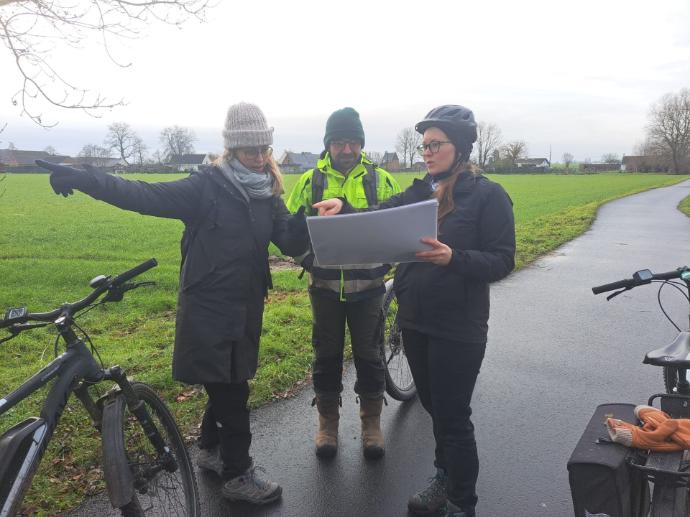
Theory vs reality
This is a great example of theory vs reality. In theory (on maps) this was ideal for phased mowing. In practice, the verges are very steep which makes it hard to implement phased mowing. The best solution was to focus on nesting areas in stead, because the verge provides a natural bee hill.
Covering 16 km by electric mountain bikes provided by the provincial enforcement team, we assessed the practical applicability of the adapted mowing approach. Along the way, everything was discussed in detail so that any necessary adjustments are clear and agreed upon by all involved.
Based on these on-the-ground insights, the technical specifications for the tender are now being fine-tuned. The updated version will be launched by the end of January. The new mowing management will then be tested in close collaboration with the groenbrigade and the contractor, with room to adjust and optimise.
The ultimate ambition is to find a solution that is feasible, effective, and scalable. One that can be rolled out across all provincial green corridors. Lessons learned will not stop at the project borders: they will be shared with project partners, other provinces, and all interested stakeholders, contributing to wider pollinator-friendly landscape management across Northwest Europe.