Sometimes a major step forward for biodiversity does not start with a new budget line or a big construction project. It starts with a tiny change in a spreadsheet.
Recently, one of colleagues (Tine Ketelaars from west-vlaanderen.be) was working together with Jan vande Walle (tree planner and creator of the image above) and the ecologist Brecht de Kezel, both members of the regional landscape organisation ‘Leie and Schelde’ (RLLS), to add one simple piece of information to a municipal tree plan to the tree plan of cross-pollinator municipality Zwevegem: the grow and flowering period of each tree species. That is all. No new software, no consultants, no months of study. Just enriching existing data with “when” each tree actually provides food for pollinators in the area.
The tree plan passed from being a static inventory and to become a calendar of nectar and pollen availability. In those ten minutes, the municipality added (Jan added this for the municipality 😊) a powerful new lens on how its urban forest supports bees, bumblebees, hoverflies and other pollinators that keep local ecosystems and agriculture running. This kind of practical step is exactly what our PolliConnect partnership is about: enhancing pollinator biodiversity through better ecological connectivity.
(Making a tree plan is a service, provided by RLLS for municipalities. This might be inspiring for other municipalities in the NWE region)
Traditionally, municipal tree plans tell us where trees are, which species they are, and sometimes their age or condition. Useful, but from a pollinator’s perspective, that is only half the story. Pollinators need food across time, not just across space.
By inserting the grow and flowering periods (phenology data) for each tree species, suddenly it became possible to scroll through the plan and see when the city is in blossom and when it is almost a desert for insects.
Spotting the “hunger gaps”
One of the most serious threats to urban pollinators is not the total absence of flowers, but gaps in the flowering season. For several weeks in late summer, or in very early spring, there can be almost nothing in bloom. We call these periods “hunger gaps”.
Once those gaps are visible, they become actionable. Future planting can target exactly those empty periods, aiming to build a continuous food-bridge from February to October, instead of a boom cycle where everything flowers at once and then there is nothing left.
Another insight is about timing at the very start of the season. Many queen bumblebees and solitary bees emerge from hibernation on cold, risky days in late winter or early spring. At that moment, trees are often their only real food source; flower beds and meadows are still asleep.
By mapping the grow period in the tree plan, the municipality can immediately see whether its tree stock offers sufficient early bloom. Are there enough willows, maples, cherries or other early-flowering species near key nesting and overwintering sites? Or are early-emerging pollinators forced to fly long distances on their first fragile days simply to find something to eat?
Strengthening early-season flowering through targeted tree choices is a low-cost way to stabilise pollinator populations for the rest of the year.
For decision-makers, this is a strong message: becoming more pollinator-friendly does not always require large budgets. Sometimes it requires a smarter view of existing assets. In this case, the urban tree plan has quietly become a decision-support tool for ecological quality and not just a maintenance list.
Some extra wins for municipalities, e.g. smarter use of the existing tools allows you to put a lever on other domains, thus maximising the impact.
From “more trees” to “the right trees”
Many cities already commit to planting a certain number of trees per year. That is positive, but without phenology data it can easily lead to monocultures that all bloom at the same time. For pollinators this is the classic “feast or famine” scenario: a short intense flowering, followed by long periods of scarcity.
Building resilience under Climate Change
Climate change is already shifting flowering times. Springs arrive earlier, late frosts hit unexpectedly, and some species start to fall out of sync with the insects that depend on them.
By documenting expected grow periods now, the municipality is also creating a baseline. If certain tree species begin to flower significantly earlier over the coming years, planners will be able to detect that drift. If a late frost repeatedly wipes out the blossom of one key tree, there will be data to show the resulting gaps in food supply.
A diversified portfolio of tree species with different flowering times acts as a safety net. If one species fails in a given year, others can step in, and pollinator populations are more likely to survive extreme events.
This small experiment offers a clear message to other cities and towns. If you already have a tree plan, you are only one simple step away from turning it into a pollinator strategy.
If you are responsible for a tree plan or green infrastructure strategy and would like to explore how to add phenology data, we are happy to exchange experiences. Sometimes, the most powerful tools for biodiversity start with a single new column in an old table.
Update your tree map and plan for pollinators!
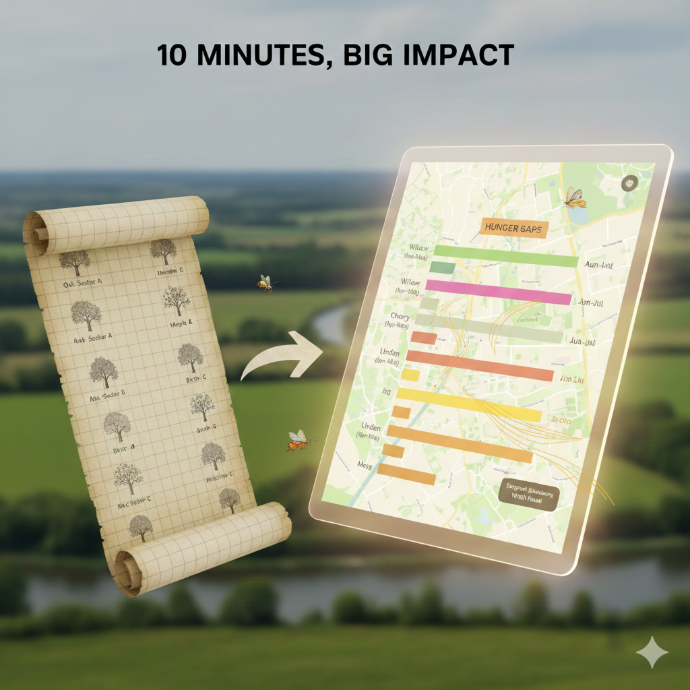
Zwevegem’s tree plan became a year-round food calendar for pollinators: turning existing data into smart data, with big biodiversity impact.